Select your language



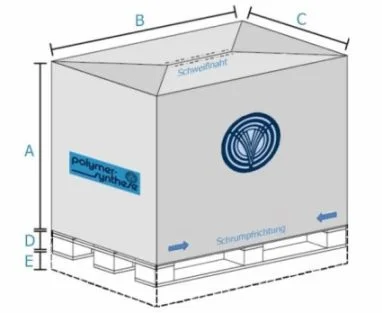
Choosing the correct shrink hood dimensions is essential to ensure reliable packaging, secure load protection and an efficient shrink-wrapping process. A shrink hood that is too small may not cover the pallet and its goods properly, while one that is too large may result in excessive film consumption or an unsuitable fit.
To determine the correct dimensions, you need to consider the pallet dimensions, the total height of the packaged goods, the material required for the side gussets and the additional film allowance needed for shrinkage.
Our guide explains how to calculate the correct shrink hood size for your pallet and how to select a suitable film thickness for your packaging requirements.
The correct shrink hood dimensions depend primarily on three factors:
For this reason, the dimensions of a shrink hood cannot be calculated simply by using the pallet length, pallet width and load height. The gusset dimensions and the required undershrink allowance must also be included.
The shrink hood height is calculated using the height of the packaged goods, half of the pallet width and an additional allowance for undershrink.
The following formula can be used for the calculation:
Shrink hood height = A + D + E + ½ C
The variables represent the relevant dimensions and allowances used in the calculation. For practical applications, the formula can be expressed as follows:
Shrink hood height = load height + half pallet width + undershrink allowance
For the calculation described in this example, an undershrink allowance of approximately 250 mm is used. The exact allowance may vary depending on the packaging configuration, film properties, load geometry and shrinking process.
In addition, suitable tolerances must be considered for the hood's length and width to compensate for the material used in the side gussets and to ensure that the hood can be fitted over the pallet load.
A standard Euro pallet measures 1,200 × 800 mm. If the goods loaded onto the pallet have a height of 1,000 mm, the required shrink hood dimensions can be calculated as follows.
Given dimensions:
Add the 50 mm allowance to the pallet length:
1,200 mm + 50 mm = 1,250 mm
Add the 50 mm allowance to the pallet width:
800 mm + 50 mm = 850 mm
Add the load height, half the pallet width and the undershrink allowance:
1,000 mm + 400 mm + 250 mm = 1,650 mm
For a Euro pallet measuring 1,200 × 800 mm with a load height of 1,000 mm, the calculated dimensions based on the stated allowances are:
1,250 + 850 × 1,650 mm
Important: If the calculation uses half of the allowance-adjusted width instead of half the nominal pallet width, the result is 1,675 mm:
1,000 mm + (850 mm ÷ 2) + 250 mm = 1,675 mm
Therefore, the required height depends on which width reference is used in the calculation. For the 1,250 × 850 mm hood dimensions specified in this example, the 1,675 mm height follows the adjusted-width method.
Before ordering, we recommend confirming the calculation with your shrink hood supplier to ensure that the dimensions are appropriate for your pallet, load and packaging process.
Selecting the correct shrink hood dimensions helps protect your goods during storage, handling and transportation. A properly sized hood can provide several benefits.
A suitable shrink hood covers the pallet load and helps prevent dust and dirt from reaching the packaged goods.
Protection against moisture
Depending on the film material, thickness and packaging configuration, shrink hoods can help protect goods against moisture and external environmental influences.
A correctly sized hood can help keep the load covered and support stable packaging during handling and transport. The overall stability of the load also depends on the product arrangement, pallet condition, film properties and packaging process.
Efficient material usage
Correctly calculated dimensions help avoid unnecessary film consumption and reduce the risk of packaging problems caused by hoods that are too small or too large.
Reliable processing
Suitable dimensions make it easier to position the hood over the load and achieve a consistent shrinking result.
The appropriate film thickness depends on the type of goods being packaged, their weight, shape, edges and sensitivity, as well as the required level of protection during storage and transportation.
We recommend the following film thicknesses, depending on the application:
These recommendations are indicative. The most suitable film thickness should be determined according to the specific packaging requirements and the performance of the selected film.
We manufacture our shrink hoods exclusively from high-quality, first-grade virgin material. This material selection supports consistent film quality and reliable processing characteristics.
Our shrink hoods can be specified in different dimensions and film thicknesses to suit a wide range of pallet packaging requirements.
Whether you need shrink hoods for standard Euro pallets or for larger industrial loads, choosing the correct dimensions and film specification is essential for achieving reliable packaging performance.
If you are unsure which shrink hood dimensions or film thickness are suitable for your application, our team can help you determine the appropriate specification for your products.
To calculate the correct shrink hood dimensions, you need the pallet length, pallet width and total load height. Add an appropriate allowance to the pallet length and width to account for the side gussets. For the height, add the load height, half the relevant pallet width and the required undershrink allowance. In the example described here, an allowance of approximately 250 mm is used.
A standard Euro pallet measures 1,200 × 800 mm. For a load height of 1,000 mm, the example calculation gives a shrink hood length of 1,250 mm and a width of 850 mm. The calculated height is 1,650 mm when using half the nominal pallet width, or 1,675 mm when using half the adjusted width. The appropriate dimension should be confirmed for the specific hood design and packaging process.
Side gussets are folded sections of film that allow a flat or folded film tube to accommodate the width and depth of the pallet load. Because this material is incorporated into the folds, the hood dimensions must account for the film required to cover the load correctly.
Undershrink refers to the additional film allowance provided so that the hood can be positioned over the load and accommodate the required coverage during the shrinking process. The necessary allowance depends on the hood design, pallet dimensions, load height and packaging conditions.
The right film thickness depends on the weight and shape of the goods, the presence of sharp edges, handling conditions and the desired level of protection. Film thicknesses of 100 µm, 125 µm and 150 µm are common options for different packaging requirements. The best choice should be confirmed based on the specific application.
Shrink hoods can help protect palletised goods against dust, dirt and moisture. The actual level of protection depends on the film, the fit of the hood, the sealing configuration and the conditions during storage and transportation.
Shrink hoods can be produced in different dimensions to accommodate various pallet sizes and load configurations. Providing accurate pallet measurements, total load height and information about the packaged goods helps determine a suitable specification.
To determine the appropriate shrink hood, provide the pallet length and width, total load height, desired film thickness, type of packaged goods and any special requirements concerning storage, transport or packaging equipment. These details help establish the correct dimensions and material specification.
Trade only with traders.
Polymer-Synthese-Werk GmbH
47495 Rheinberg/Germany
Manufacturer of bags, films and tubes made of LDPE, MDPE and PP.
Telephon: +49 2844 100
Fax : +49 2844 1015
Mail : info@polymersynthese.com