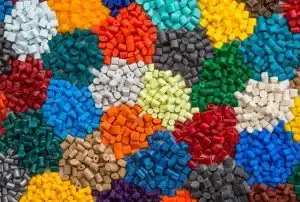
The term masterbatch refers to concentrated plastic additives in the form of granules. Masterbatches are also commonly described as polymer-bound additives or additive concentrates.
A masterbatch consists of a carrier polymer containing a high concentration of pigments, dyes or functional additives. During plastic processing, the masterbatch is added to the natural polymer, also known as the natural resin or base polymer, in a defined dosage.
This allows the properties and appearance of the finished plastic product to be adjusted precisely to the requirements of the application.
Masterbatches are widely used in the plastics industry, including in the production of films, bags, tubing, packaging and technical plastic products.
At Polymer Synthese Werk, masterbatches allow us to tailor the properties of our films and packaging materials to individual customer requirements.
Why Use Masterbatch?
Compared with directly adding pigments or additives in the form of powders, pastes or liquids, masterbatches offer several important advantages.
Because the active ingredients are already incorporated into a polymer carrier, masterbatches can generally be:
-
Dosed accurately
-
Processed cleanly
-
Distributed more uniformly
-
Stored and handled easily
-
Integrated into continuous production processes
-
Used with comparatively high process reliability
The granular form also simplifies handling and automated dosing during extrusion.
This makes masterbatch technology particularly suitable for the continuous production of plastic films.
How Does Masterbatch Work?
A masterbatch is added to the natural polymer in a defined concentration before or during processing.
The masterbatch carrier is compatible with the base polymer and distributes the pigments or additives throughout the melt during processing.
The final concentration of the active ingredient depends on the desired properties and the selected masterbatch.
For example, a color masterbatch can be used to transform a natural, translucent film into a colored transparent or opaque film. An additive masterbatch can be used to introduce properties such as UV stabilization, antistatic behavior, slip or antiblock characteristics.
The dosage is selected according to the desired end-product properties, material, film thickness and processing conditions.
The Three Main Types of Masterbatch
Masterbatches can generally be divided into three main categories:
-
Color Masterbatches
-
Additive Masterbatches
-
Combination Masterbatches
Each type serves a different purpose and can be selected individually or combined with other masterbatches.
Color Masterbatches
Coloring Plastic Films and Products
Color masterbatches are used to give plastic products a specific color or optical appearance.
Instead of adding pigments directly to the polymer, highly concentrated color pigments are incorporated into a carrier polymer and supplied as granules.
During processing, the color masterbatch is added to the natural polymer at the required dosage.
Depending on the formulation, concentration and film thickness, this can produce:
-
Transparent colored films
-
Translucent films
-
Opaque films
-
Strongly colored products
-
Pastel shades
-
Customized colors
The final color can be adjusted to meet customer requirements.
Color masterbatches are therefore an efficient method for producing consistent and reproducible colors in plastic films and packaging products.
Customized Colors
For many applications, color is more than a visual feature. It can be used for product identification, branding, differentiation or functional purposes.
Depending on the application, customized color solutions can be developed to match specific customer requirements.
The final appearance depends on factors such as:
-
Pigment concentration
-
Polymer type
-
Film thickness
-
Transparency
-
Processing conditions
-
Surface characteristics
Additive Masterbatches
Masterbatches for Functional Properties
While color masterbatches primarily change the appearance of a plastic product, additive masterbatches are used to modify its functional properties.
They allow specific characteristics to be introduced or improved without changing the basic polymer.
Common additive masterbatch applications include:
-
UV stabilization
-
Flame retardancy
-
Antistatic properties
-
Antiblock properties
-
Slip properties
-
Antislip properties
The appropriate additive and concentration depend on the intended application and the desired final properties.
UV Stabilization
Polyolefins such as polyethylene can be affected by prolonged exposure to ultraviolet radiation.
UV-stabilizing masterbatches can improve the resistance of films and other plastic products to UV exposure and help maintain their mechanical and optical properties for longer periods.
Different stabilizer systems and concentrations can be selected depending on:
-
Expected UV exposure
-
Application duration
-
Film thickness
-
Climate
-
Outdoor or indoor use
-
Required service life
UV stabilization is particularly relevant for products used outdoors, such as agricultural films, construction films, protective covers and certain industrial packaging applications.
Flame-Retardant Masterbatch
Improving Fire Performance
Flame-retardant masterbatches are used to modify the fire behavior of plastic products.
The required formulation and concentration depend on the polymer, product design and film thickness.
For certain applications, appropriate formulations can be used to achieve specified fire classifications, such as B1 or B2 according to DIN 4102, or classifications under EN 13501-1, where the complete product construction and applicable test requirements determine the final classification.
It is important to distinguish between the flame-retardant additive itself and the classification of the finished product. Fire performance always has to be verified for the specific material, thickness, construction and application.
Antistatic Masterbatch
Reducing Electrostatic Charge
Polyethylene and other plastics are naturally electrically insulating. During processing and handling, this can result in the accumulation of electrostatic charges on the surface.
Antistatic masterbatches can be used to reduce surface resistivity and improve the antistatic behavior of the finished product.
This can be particularly useful in applications where static electricity can cause:
-
Dust attraction
-
Handling problems
-
Material sticking
-
Electrostatic discharge
-
Processing difficulties
The appropriate formulation depends on the required electrical properties and the intended application.
Antiblock Masterbatch
Preventing Film Blocking
Plastic films can sometimes tend to stick to themselves after extrusion, particularly when layers of film come into close contact.
This phenomenon is known as blocking.
Antiblock masterbatches are used to reduce the tendency of film surfaces to adhere to each other.
This can provide several advantages:
-
Easier film handling
-
Improved roll unwinding
-
Reduced film-to-film adhesion
-
More reliable downstream processing
-
Improved converting performance
Antiblock additives can be particularly important in the production and processing of thin polyethylene films.
Antiblock and Slip Properties
Antiblock systems can also be combined with suitable slip additives.
The interaction between antiblock and slip properties is important because the film must not only separate easily, but also exhibit the appropriate friction characteristics during processing and use.
The correct balance depends on the intended application and the machinery used to process the film.
Slip Masterbatch
Improved Sliding Properties
Slip masterbatches are used to reduce the coefficient of friction of a plastic film.
This can provide an improved gliding effect and make films easier to process.
Slip properties can be particularly important for:
-
Packaging machinery
-
Film handling
-
Automatic filling processes
-
Bag production
-
Film converting
-
Roll processing
Slip masterbatches can also be combined with antiblock masterbatches to achieve a suitable balance between easy sliding and reduced film-to-film adhesion.
Combining Slip and Antiblock
In many film applications, it is not sufficient to optimize only one surface property.
A film may need to:
-
Unwind easily from a roll
-
Run smoothly through machinery
-
Avoid blocking
-
Maintain sufficient grip
-
Provide reliable handling
For this reason, slip and antiblock systems are often selected and adjusted together.
The right balance depends on the film formulation, thickness, machinery, processing speed and final application.
Antislip Masterbatch
High-Friction Film Surfaces
In contrast to slip additives, antislip masterbatches are used where a higher coefficient of friction is required.
This can be particularly useful for high-performance polyethylene bags and packaging products where the packaging needs to remain securely in position during handling, stacking or transport.
Antislip formulations can provide a combination of:
-
Good antiblocking behavior
-
Increased surface friction
-
Improved grip
-
Better handling stability
This is particularly useful where packages should not slide easily against each other or against other surfaces.
Combination Masterbatches
Color and Additives in One Concentrate
Combination masterbatches, sometimes referred to as combi masterbatches, contain both colorants and functional additives.
This means that a single concentrate can be used to provide both the desired color and specific functional properties.
For example, a combination masterbatch could be formulated to provide:
-
A specific color
-
UV stabilization
-
Antistatic properties
-
Antiblock properties
-
Slip properties
The exact combination depends on the requirements of the finished product.
Combination masterbatches can simplify dosing and production because several components can be introduced through one concentrate.
Masterbatch in Film Production
Masterbatch technology is particularly important in plastic film extrusion.
During the extrusion process, the selected masterbatch is incorporated into the polymer melt. The pigments or additives are distributed throughout the material and influence the properties of the finished film.
The correct dosing and processing conditions are essential for achieving consistent results.
Factors such as the following can influence the final product:
-
Base polymer
-
Masterbatch carrier
-
Additive concentration
-
Pigment concentration
-
Film thickness
-
Extrusion temperature
-
Processing speed
-
Cooling conditions
-
Film structure
Professional formulation and processing are therefore important to achieve consistent film properties.
Polymer-Bound Additives
One of the main advantages of masterbatch technology is that the additives are bound into a polymer carrier.
This distinguishes masterbatches from many additives supplied as free powders, liquids or pastes.
The polymer carrier improves handling and allows the concentrated additives to be introduced into the production process in a controlled manner.
This is particularly advantageous for continuous industrial processes such as film extrusion.
Masterbatch and Process Reliability
Masterbatches can contribute significantly to process reliability.
Their granular form allows them to be stored, transported and automatically dosed with relative ease. Accurate dosing helps maintain consistent color and additive concentrations throughout production.
For industrial film production, this can help achieve stable and reproducible product properties.
Consistent dosing is particularly important when producing films to tight customer specifications.
Masterbatch Selection
The choice of masterbatch should always be based on the requirements of the finished product.
Important considerations include:
-
Base polymer
-
Processing method
-
Processing temperature
-
Desired color
-
Required additive concentration
-
Film thickness
-
Surface properties
-
Indoor or outdoor application
-
UV exposure
-
Electrical requirements
-
Required friction characteristics
-
Packaging and converting process
A masterbatch that works well in one application may not be suitable for another.
For this reason, the formulation should always be considered together with the complete film and production process.
Masterbatch for Customized Film Solutions
At Polymer Synthese Werk, masterbatches are an important tool for adapting plastic films and packaging materials to specific customer requirements.
By selecting suitable color and additive concentrates, we can influence both the appearance and functional properties of our products.
Depending on the application, this may include:
-
Color adjustment
-
UV stabilization
-
Antistatic properties
-
Antiblock properties
-
Slip properties
-
Antislip properties
-
Flame-retardant properties
The appropriate formulation is selected according to the requirements of the final product.
From Natural Polymer to Customized Film
Masterbatch technology allows us to transform a natural polymer into a customized film with defined optical and functional properties.
The process can be summarized as:
Natural polymer → Masterbatch addition → Extrusion → Film → Customized properties
The final result is a film that is not only manufactured to the required dimensions, but can also be adapted to the desired technical characteristics.
The Origin of the Term "Masterbatch"
The term masterbatch is generally associated with the concept of producing a highly concentrated mixture that is subsequently diluted into a larger quantity of polymer.
The term is also historically linked to terminology used in the rubber industry, where concentrated mixtures were prepared and later incorporated into larger production batches.
Today, masterbatch is an established term throughout the plastics industry.
In German-speaking industrial terminology, masterbatches are also commonly referred to as color concentrates, additive concentrates or combination concentrates.
Masterbatch Expertise for Plastic Films
Masterbatch technology gives manufacturers a powerful tool for modifying the appearance and functional properties of plastic films.
At Polymer Synthese Werk, we use color and additive concentrates as part of our flexible film manufacturing processes to meet individual customer requirements.
Whether you need a specific color, improved UV resistance, antistatic properties, controlled slip, antiblock performance or a combination of several properties, the appropriate masterbatch system can be incorporated into the film formulation.
Customized Film Properties – According to Your Requirements
We advise our customers on the selection of suitable materials, additives and masterbatch systems for their application.
Tell us about your requirements. Together, we will develop the right film solution with the appropriate combination of material, color and functional properties.