
Oxygen permeability is one of the key parameters used to evaluate the protective performance of packaging materials. Oxygen can contribute to oxidation processes, which may affect the colour, flavour, quality and shelf life of sensitive products. In food packaging, for example, limiting oxygen transmission can help preserve product quality and reduce oxidative deterioration.
Polyethylene generally offers relatively good resistance to water vapour transmission but is not considered a high-performance oxygen barrier compared with materials specifically developed for gas barrier applications. Oxygen can diffuse through the polymer structure, and the rate of transmission depends on the molecular structure of the polyethylene, the film thickness, the temperature, the humidity and the surrounding oxygen concentration.
The oxygen barrier performance of a PE film is commonly described using its oxygen transmission rate (OTR) or its oxygen permeability coefficient. These parameters provide information about how readily oxygen passes through the material. When comparing different films, it is important to use consistent test conditions and distinguish between permeability, which accounts for material thickness, and transmission rate, which relates to the performance of a film of a given thickness.
In general, lower oxygen transmission rates indicate better protection against oxygen ingress. The appropriate target value depends on the sensitivity of the packaged product and the intended storage conditions.
Differences Between HDPE and LDPE
Polyethylene is available in different grades, each with its own molecular structure and performance characteristics. Two of the most widely used types are high-density polyethylene (HDPE) and low-density polyethylene (LDPE).
High-Density Polyethylene (HDPE)
HDPE has a predominantly linear molecular structure with relatively little branching. Its polymer chains can therefore pack more closely together, resulting in a higher density and generally greater crystallinity than LDPE.
This compact structure typically reduces the pathways available for gas molecules to diffuse through the material. As a result, HDPE generally exhibits lower oxygen permeability than LDPE of comparable thickness when measured under equivalent conditions.
In addition to its barrier characteristics, HDPE offers good stiffness, strength and chemical resistance. These properties make it suitable for a wide range of applications, including packaging, containers, liners and technical films.
Low-Density Polyethylene (LDPE)
LDPE contains a greater degree of branching in its molecular structure. This branching limits the ability of the polymer chains to pack closely together and generally results in a lower density and lower crystallinity.
Consequently, LDPE typically allows oxygen to pass through more readily than HDPE under comparable conditions. Nevertheless, LDPE offers other important advantages, including flexibility, softness, good processability and effective moisture barrier properties.
These characteristics make LDPE particularly suitable for flexible packaging films, protective covers, bags and applications where adaptability and ease of processing are essential.
The choice between HDPE and LDPE therefore depends on the overall requirements of the application. Oxygen permeability is an important consideration, but it should be assessed alongside mechanical properties, moisture resistance, flexibility, sealing performance and cost.
The Influence of Film Thickness and Processing
Film thickness has a significant influence on the barrier performance of polyethylene. Under otherwise comparable conditions, increasing the thickness of a homogeneous film generally reduces the amount of gas transmitted through it per unit area and time.
For this reason, thicker films may provide improved protection against oxygen transmission. However, increasing thickness also affects material consumption, weight, flexibility and production costs. The optimum film thickness must therefore balance the required barrier performance with the practical demands of the application.
Processing conditions and material quality can also influence barrier properties. Variations in polymer structure, crystallinity, orientation and the presence of additives may affect the way gas molecules move through the material. Furthermore, defects, pinholes, uneven thickness and damage to the film can compromise its effective barrier performance.
For reliable results, barrier properties should be measured using standardized test methods and under conditions representative of the intended application.
Improving Barrier Performance with Additional Layers and Coatings
When the natural barrier properties of polyethylene are insufficient for a particular application, additional measures can be used to improve the overall performance of the packaging material.
One option is to combine polyethylene with other polymers or specialized barrier materials in a multilayer film structure. Each layer contributes specific properties to the finished product. Polyethylene, for example, can provide flexibility, moisture resistance and heat-sealing performance, while a dedicated barrier layer can significantly reduce oxygen transmission.
Depending on the application, materials such as ethylene vinyl alcohol (EVOH) or polyamide (PA) may be incorporated into multilayer structures to improve gas barrier performance. Suitable tie layers may be required to ensure reliable bonding between incompatible materials.
Specialized coatings and surface treatments can also be used in certain applications. Their effectiveness depends on the coating chemistry, layer thickness, processing conditions and intended use.
The selection of an appropriate multilayer structure or coating system requires consideration of the complete packaging design, including mechanical strength, sealing properties, product compatibility, processing requirements and end-of-life considerations.
Barrier Properties in Food Packaging
Food packaging is one of the most important applications in which the barrier properties of polyethylene must be carefully evaluated. Oxygen transmission can influence the oxidation of fats and oils, the stability of flavours, colour retention and the overall quality of oxygen-sensitive products.
Water vapour transmission is equally important for products that must retain their moisture content or remain protected from external humidity. Polyethylene is widely used for this purpose because it generally provides an effective moisture barrier.
However, the requirements vary considerably between products. Some applications primarily require protection against moisture, while others demand very low oxygen transmission or the retention of specific aromas. In these cases, a single-layer PE film may not provide sufficient protection, and a multilayer construction or an additional barrier solution may be necessary.
The suitability of a packaging material should therefore be determined by evaluating the sensitivity of the product, the expected shelf life, the storage temperature, the distribution environment and the required level of protection.
Selecting the Right Polyethylene Film
Choosing the appropriate polyethylene film requires a comprehensive assessment of the intended application and its performance requirements. Important factors include the type of substance to be contained or excluded, the desired barrier level, film thickness, mechanical demands, processing conditions and environmental exposure.
HDPE may be advantageous where a relatively compact polymer structure and improved oxygen barrier performance are required. LDPE is often preferred where flexibility, sealability and moisture protection are the primary considerations. Where particularly high oxygen barrier performance is necessary, combining PE with a suitable barrier material may be the most effective solution.
Ultimately, the best material is not determined by a single property. It is the result of balancing barrier performance, mechanical strength, flexibility, processability, product protection and economic efficiency.
By selecting the appropriate polyethylene grade, film thickness and, where necessary, additional barrier layers, manufacturers can develop packaging solutions tailored to the specific demands of their products and applications.
Depending on the film thickness, the following oxygen permeability values can be achieved:
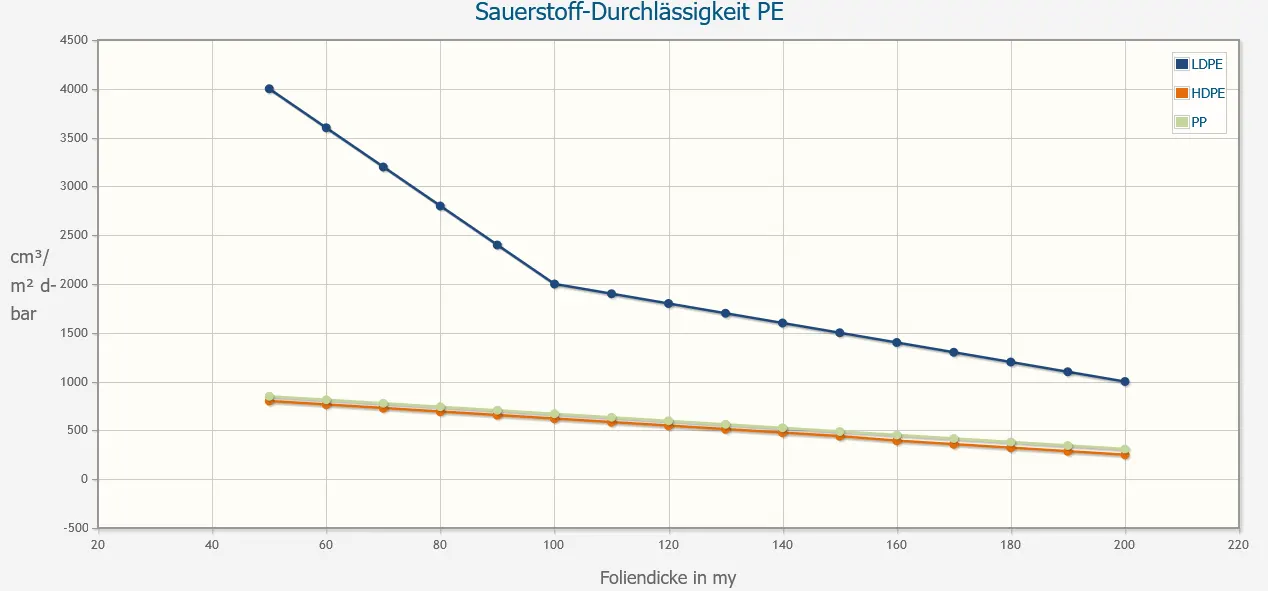
PE-LD films have low water vapor permeability and relatively high oxygen permeability.
The oxygen permeability of packaging films is usually measured on a flat film at a defined point at a temperature of around 23 ºC. The measuring method (DIN 53380-3) is standardized and very complex.