



History Polymer Synthese Factory


1950
Foundation of the company Polymer Synthese Werk Rudolf Klaus &Co. KG by Rudolf Klaus in Mülheim/Ruhr. A technical production plant with completely new manufacturing processes had to be planned and built to process the raw material "polyethylene" that was available at the time. With the construction of the plant, new paths had to be explored. Since work was being done in a still unknown production area, setbacks were inevitable. But thanks to Rudolf Klaus many years of industrial experience as an employee in large chemical plants, the hard work on the construction led to success. Not only did industrial processes for the production of the raw materials have to be developed, but also the machines for the film production. Consequently, new machines were designed and built in collaboration with the chemical, mechanical and electrical industries.

1951
In 1951 the first film processing systems were delivered. Founding of the Polymer Synthese Factory GmbH. Production started with four employees. The daily production was initially 100 kg or 10,000 running meters. The economic upswing in the years after the currency reform gave the new plastic access to new packaging areas in the chemical industry due to its outstanding, hitherto unknown excellent properties. This marked the start of the companys ascent and the progressive expansion of production.

1956

1962

1970
In 1970, the Polymer-Synthese-Factory GmbH was established in response to the company's continuous growth and the increasing scale of its business operations. The expansion of the company had created a need for a new organizational structure that could accommodate its growing production activities and support further development. At the same time, demand for the company's products continued to rise rapidly, creating new opportunities for expansion and increasing the need for greater manufacturing capacity. To meet these growing requirements, the company invested in the acquisition of the latest film extrusion technology available at the time. The introduction of these modern extrusion lines significantly improved production efficiency and enabled larger quantities of film to be manufactured within the same period. As a result of these investments and the continued growth in demand, daily production output could once again be substantially increased. The establishment of Polymer-Synthese-Factory GmbH, combined with the modernization of the production facilities, represented an important milestone in the company's development. It strengthened the company's ability to respond to the expanding market, meet customer requirements more effectively, and lay the foundations for further growth in the plastics processing industry.

1977
On March 4, 1977, a devastating fire destroyed the entire factory site, reducing the production facilities and all machinery to their foundations. The fire caused extensive damage to the premises, leaving the factory completely unusable and bringing all production operations to a standstill. Fortunately, no production activities were taking place at the time the fire broke out, meaning that no personal injuries were reported. Following the fire, the site was cleared of debris and the necessary clean-up work was carried out. Immediately after these operations were completed, reconstruction began without delay, marking the first step toward rebuilding the factory and restoring its production capabilities.

1985
Following the death of company founder Rudolf Klaus in 1985, the management of the company was taken over by his sons, Axel-Uwe Klaus and Holger Klaus. This marked an important transition in the company's history, as the next generation assumed responsibility for its continued development and future direction. Under their leadership, the company underwent a strategic realignment of its production activities. The processing of polystyrene and polyamide was discontinued, allowing the business to concentrate its resources on other areas of plastics manufacturing. At the same time, production capacity for low-density polyethylene (LDPE) was systematically expanded through the installation of new extrusion lines. These investments strengthened the company's capabilities in LDPE processing and reflected its decision to focus on this area of production. The changes represented a significant step in the company's development, reshaping its product portfolio and establishing a more specialized production structure under the management of the second generation of the Klaus family.

1992
The commissioning of a new production line marked another important milestone in the company's development and represented a step toward expanding its product portfolio into specialized industrial applications. The new line was designed for the manufacture of trash compactor boxes, which combined polyethylene with corrugated cardboard to create a material solution tailored to the specific requirements of the aviation industry. By bringing together the properties of these two materials, the company developed a product intended for use in applications where functional performance, practicality, and efficient waste handling were essential. The polyethylene component provided a durable, moisture-resistant surface, while the corrugated cardboard offered a lightweight structure suitable for the intended application. The combination of these materials made it possible to manufacture specialized components for aircraft waste-compaction systems. The introduction of this production line demonstrated the company's ability to adapt its plastics processing expertise to the needs of a highly specialized market. It also illustrated the potential of combining different materials to develop innovative products for demanding industrial customers. With this expansion, the company broadened its manufacturing capabilities beyond conventional plastic film production and established an additional area of activity focused on customized solutions for the aviation sector.

2020
On May 8, 2020, Dipl.-Ing. Axel-Uwe Klaus passed away, marking the end of an era in the company's history. He had dedicated more than 50 years of his life to the business, including over 35 years as its managing director. Throughout these decades, he played a central role in the company's development, contributing to its growth, the expansion of its production capabilities, and the continued evolution of its business activities. His long-standing commitment helped shape the company's identity and maintain its position in the plastics processing industry. Following his passing, Christiane Klaus succeeded him, assuming responsibility for the company's continued management and future direction. Her succession ensured continuity in the leadership of the family business while also marking the beginning of a new chapter in its history. Despite the changes in leadership over the years, the company has remained under family ownership. Today, it continues to be managed within the Klaus family in its third generation, preserving the entrepreneurial tradition established by its founder while carrying the business forward into the future. This continuity reflects the family's enduring commitment to the company, its accumulated experience, and its long-term development across several generations.

2021
This year, we had the pleasure of celebrating our 70th company anniversary, marking seven decades of history, development, and entrepreneurial commitment. This significant milestone represents not only the longevity of our business but also the dedication, perseverance, and expertise that have shaped the company throughout its history. Since its beginnings, the company has continually evolved in response to changing market conditions, technological advancements, and the growing demands of its customers. Over the years, investments in modern production technologies, the expansion of manufacturing capabilities, and the development of specialized products have contributed to the company's continued growth and progress. Equally important has been the commitment of the people behind the business, whose knowledge, experience, and hard work have helped establish and maintain its position in the plastics processing industry.
2026
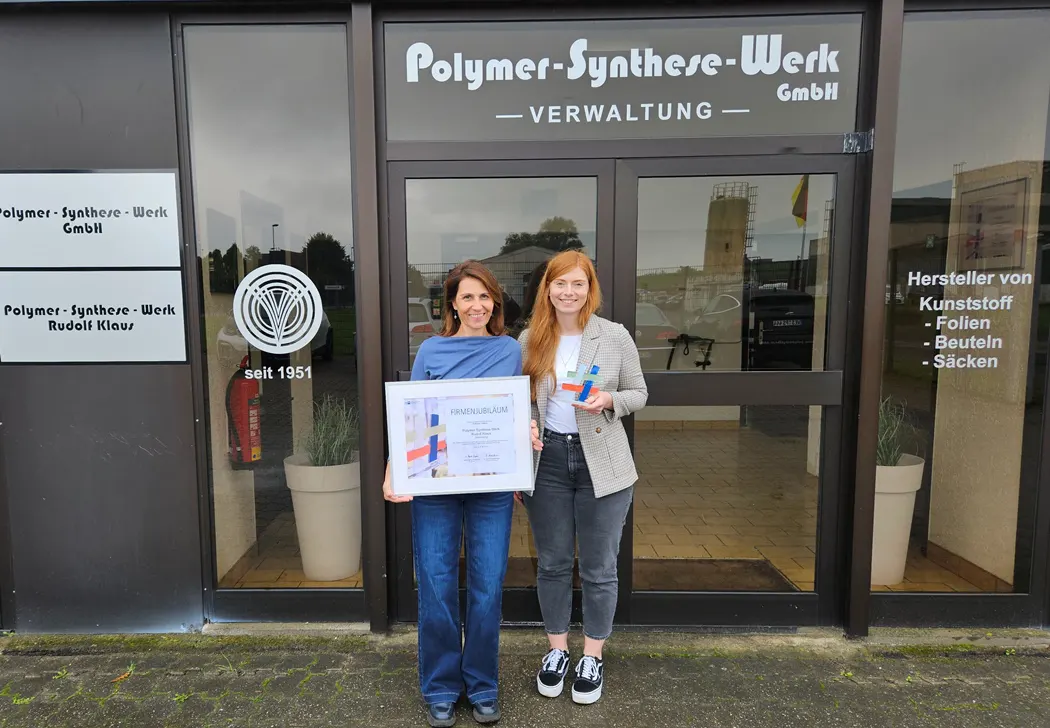
This year, we are proud to celebrate our 75th company anniversary, marking three-quarters of a century of entrepreneurial spirit, continuous development, and dedication to the plastics processing industry. This remarkable milestone reflects the company's long-standing tradition, the experience gained over generations, and the commitment that has driven its progress throughout the decades.
Since its foundation, the company has continually adapted to changing market conditions, embraced technological advancements, and responded to the evolving needs of its customers. Through ongoing investments in modern production technologies, the expansion of manufacturing capabilities, and the development of specialized products, the company has consistently strengthened its expertise and broadened its range of services. These achievements have been made possible not only by technical innovation and entrepreneurial vision but also by the dedication, knowledge, and hard work of its employees, whose contributions have played an essential role in shaping the company's history and ensuring its continued success.
Celebrating 75 years in business is an opportunity to look back with pride on the milestones achieved, the challenges overcome, and the lasting relationships built with customers and business partners. At the same time, this anniversary represents a commitment to the future: continuing the company's tradition of quality, reliability, and innovation while pursuing new opportunities for growth and development. With the experience of three-quarters of a century behind us, we look forward to continuing our journey and building on the foundations established by previous generations.
